
More relevant visibility
Local SEO helps your business appear for searches connected to your genuine products, services and service area rather than attracting unrelated traffic.
Local Search Strategy for Thrissur Businesses
Thrissur local SEO is the process of improving a business so that nearby customers can discover it through Google Search and Google Maps. It combines Google Business Profile optimisation, local website content, genuine reviews, technical SEO, trusted mentions and performance tracking. This guide by Anson PJ explains how local businesses can build stronger visibility without depending on shortcuts or keyword stuffing.
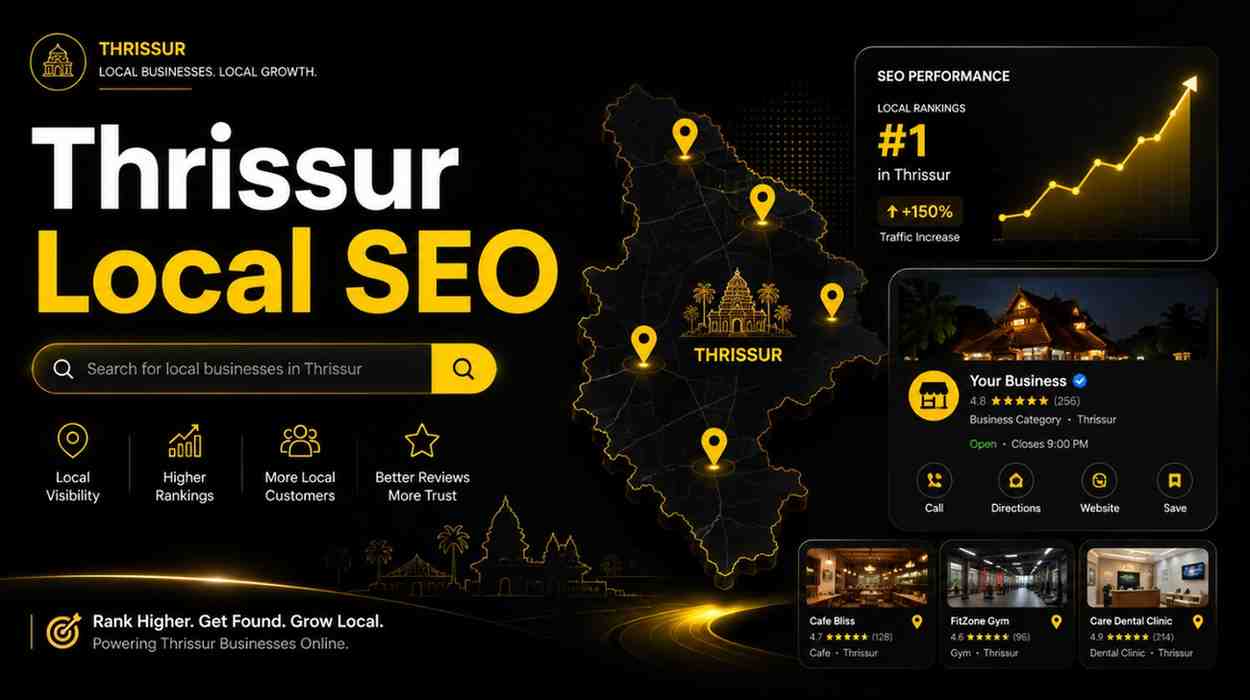 Google Search, Maps, reviews and local website optimisation.
Thrissur local SEO helps a business become more relevant and trustworthy for searches made by people in or around Thrissur. A successful strategy does not focus only on one keyword. It connects an accurate Google Business Profile, useful service pages, local proof, real customer reviews, strong mobile performance and consistent business information across the web.
Why local search matters
A person searching for a service in Thrissur may be ready to call, request directions, send a WhatsApp message, compare reviews or visit a business. Local SEO improves the information and digital signals that help Google understand what the business offers, where it operates and whether it appears useful for that search.
Local SEO helps your business appear for searches connected to your genuine products, services and service area rather than attracting unrelated traffic.
Accurate information, recent photos, useful service pages and authentic reviews reduce uncertainty before a customer contacts the business.
Calls, website clicks, form submissions, direction requests and qualified leads can be tracked to understand whether local visibility supports business growth.
How Google evaluates local results
Google’s official local ranking guidance explains that local results are mainly based on relevance, distance and prominence . There is no method that guarantees the first position for every person in every area because distance and search context can change from one user to another.
Relevance measures how closely your business information, category, services and website content match the meaning of the customer’s search.
Distance considers how far the business is from the location used in the search. This cannot be solved by adding fake locations or creating ineligible profiles.
Prominence is connected to how established the business appears. Reviews, links, articles, directories, website visibility and real-world reputation may contribute.
Complete local SEO strategy
The strongest strategy connects profile optimisation, website SEO, local authority and customer experience. Follow these steps in sequence and measure progress instead of making frequent random changes.
First, add or claim your Google Business Profile . Then use the genuine real-world business name, correct address or service area, primary phone number, website, opening hours and relevant attributes. Follow the official Google Business Profile guidelines instead of adding promotional keywords to the business name.
Each important service should have a dedicated page that explains the customer problem, service process, suitable audience, proof, service area and next action. Mention Thrissur naturally where it is useful, but do not repeat the keyword in every sentence.
Your business name, address or service area, phone number and website should be accurate across the Business Profile, website, social profiles and trustworthy directories. Small formatting differences are usually less important than genuinely conflicting information.
Follow Google’s official review guidance and ask satisfied customers for honest Google reviews after a completed service or purchase. Reviews should reflect real experiences. Reply professionally, acknowledge specific feedback and avoid purchasing reviews or using review manipulation.
Google recommends helpful, reliable, people-first content . Create content from real customer questions, local experience, project knowledge and subject expertise rather than rewriting generic information already available everywhere.
Prominence can be supported by legitimate mentions and links from organisations connected to your business, industry or locality. Focus on real relationships and useful references rather than purchasing large quantities of low-quality backlinks.
Most local searches happen on mobile devices. Pages should load efficiently, show important information clearly and make calls, directions, forms or WhatsApp actions easy to use. Google’s Core Web Vitals guidance recommends good thresholds of LCP within 2.5 seconds, INP below 200 milliseconds and CLS at or below 0.1.
Use Google’s LocalBusiness structured data guide and add suitable Organization, LocalBusiness, Breadcrumb or other relevant structured data only when it accurately represents the visible page. Structured data can help Google understand page details, but it does not guarantee a rich result or higher ranking.
Use Google Search Console, Google Business Profile performance, analytics and lead records together. Also build and submit an XML sitemap so Google can discover important website URLs more efficiently. Rankings alone do not show whether local SEO is generating useful business outcomes.
2026 search updates
There is no single “new local SEO algorithm” with a fixed checklist. Google uses multiple ranking systems and releases broad updates. For a local business, the practical response is to improve real usefulness, accuracy, trust, originality and technical accessibility rather than chasing a secret keyword formula.
Google’s June 2026 spam update applied globally and across all languages. Local sites should avoid scaled low-value pages, fake reviews, manipulative links, misleading locations and other tactics designed mainly to influence rankings.
Content should answer a real customer need, demonstrate knowledge or experience and leave the reader with enough information to make a decision. Repeating “Thrissur local SEO” does not replace useful content.
Google states that the same foundational SEO practices apply to its AI features. Important content should be crawlable, available as text, supported by useful images where relevant and connected through clear internal links.
Business-specific examples, original photographs, local observations, transparent authorship and useful source references provide more value than generic content that could have been published for any city.
Review of the shared SEO limits image
The shared image contains a mixture of official technical limits, industry recommendations and simplified rules. Use practical targets for quality control, but do not treat every number as a Google algorithm requirement.
| Item in the image | Updated interpretation | Status |
|---|---|---|
| Meta title: 50–60 characters | A concise title is useful, but Google states that there is no fixed title-character limit. Titles may be truncated according to device width and Google may generate a different title link. | Practical target |
| Meta description: 140–160 characters | This is a sensible writing range for many pages, but not a hard Google limit. Snippets are truncated as needed and Google may use page content instead of the supplied description. | Practical target |
| One unique H1 per page | One clear main heading is a strong usability practice. Google does not publish a ranking rule that a page must contain exactly one H1, but headings should represent the page structure clearly. | Best practice |
| Image size below 200 KB | Smaller files can improve performance, but 200 KB is not a universal Google limit. Use the smallest file that preserves the required quality, dimensions and format. | Performance target |
| Sitemap: 50 MB or 50,000 URLs | Correct for one uncompressed sitemap. Larger sites should divide URLs into multiple sitemaps and may use a sitemap index. | Official limit |
| Alt text: 60–125 characters | Google recommends useful, descriptive alt text in context, not a fixed character range. Decorative images may use empty alt text where appropriate for accessibility. | No fixed limit |
| Anchor text: 2–5 words | Anchor text should be descriptive, concise and natural. There is no fixed 2–5 word requirement, and repeated exact-match anchors should not be forced. | Writing guideline |
| URL length below 75 characters | Short readable URLs are useful, but 75 characters is not an official ranking limit. Use stable URLs with descriptive words and avoid unnecessary parameters. | Practical target |
| Content length: 1,000–2,500 words | Google does not require a fixed article length. Content should be long enough to satisfy the search intent without filler, repetition or missing important information. | Intent-based |
| Internal links: no fixed limit | Correct in principle. Add relevant contextual links that help users and crawlers understand relationships between pages. | Correct principle |
| Core Web Vitals | The good thresholds shown for LCP, INP and CLS match Google’s published guidance, but good scores alone do not guarantee top rankings. | Official thresholds |
| Google Business Profile description: 750 characters | The Business Profile description field supports up to 750 characters. It should focus on the business, services, mission and history rather than promotions, links or keyword stuffing. | Official field limit |
| Crawlable HTML: about 15 MB | This figure is outdated for current Google documentation. Google’s updated Googlebot documentation states that the first 2 MB of a supported file type is crawled for Google Search. | Outdated in image |
Local SEO page checklist
A locally optimised page should demonstrate relevance without becoming repetitive. The page must be easy to understand for a customer, accessible to Google and connected to genuine business evidence.
This article can also internally link to the detailed guide on how to get a Thrissur business on Google Search , the selected digital marketing work and other SEO and marketing articles .
Frequently asked questions
Local SEO in Thrissur is the process of improving a business’s visibility for nearby searches through Google Business Profile, local website optimisation, reviews, consistent business information, relevant mentions and technical SEO.
There is no fixed timeline. Some profile corrections may be reflected relatively quickly, while stronger organic visibility and local prominence can take several months. Competition, location, website condition, business history and implementation quality affect the timeline.
No. Repeating the location unnaturally does not create a strong local page. Use the place name where it helps clarify the service area and provide useful local information, proof and context.
Google states that review count and score are considered within local prominence. Reviews also influence customer trust. The reviews must be genuine and should not be purchased, exchanged or manipulated.
A complete Business Profile is important, but competitive local visibility can also depend on website quality, relevance, reviews, links, mentions, prominence, distance and overall customer experience.
Google focuses on content quality rather than the production method. Automatically generated content should still be accurate, original, useful, relevant, transparent and created for people rather than published at scale only to manipulate rankings.
Businesses can review Anson PJ’s digital marketing profile in Thrissur and selected campaign work before discussing a local SEO strategy.
Work with Anson PJ to improve Google Business Profile accuracy, local website relevance, content quality, technical SEO, search tracking and conversion opportunities. Review the selected work before starting.
Local rankings are not guaranteed. Results vary according to relevance, distance, prominence, competition, eligibility, website quality, customer experience and ongoing optimisation. The featured image is supplied from the Anson PJ website and the external references used in this article are official Google documentation.