 Anson PJ
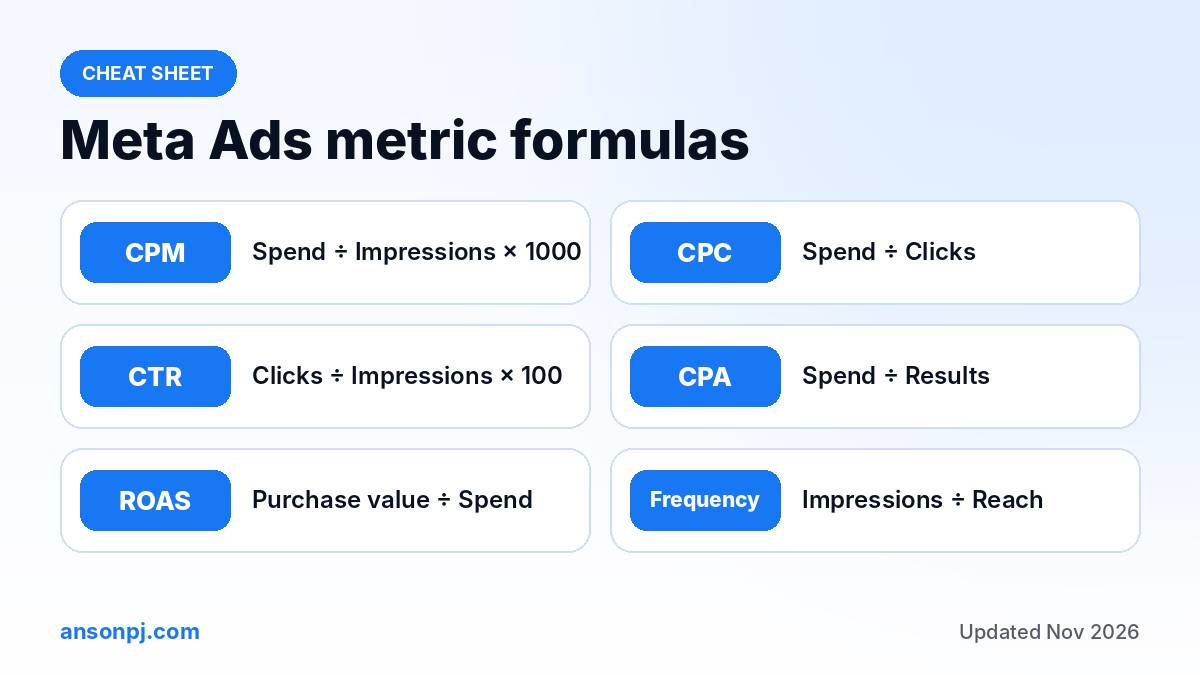
Meta Ads terms are the settings and metrics you see in Meta Ads Manager. The five that matter most are CPA (cost per result: spend ÷ results), CPM (cost per 1,000 impressions), CTR (link clicks ÷ impressions × 100), ROAS (purchase value ÷ spend) and frequency (impressions ÷ reach). Together they tell you whether your ads are cheap to show, interesting to click and profitable to run.
When I open a client's Meta Ads account for the first time, the most common question I hear is simple: "What do all these columns mean?" This glossary answers that, in the same order you'll meet the terms inside Meta Ads Manager: account setup, budget, audience, delivery, engagement, results, tracking and creative.
Section 1Account and campaign structure terms
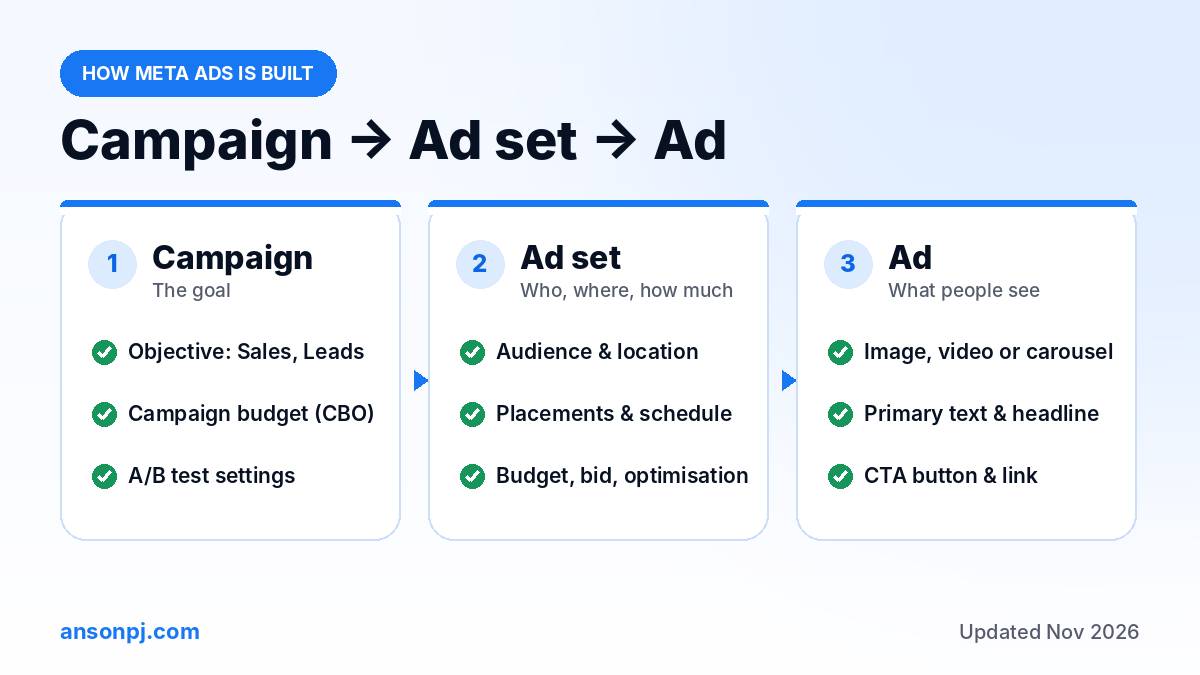
Every Meta ad lives inside a three-level structure. Get this right and every other term becomes easier to understand.
Meta Ads Manager
Meta's free tool for creating, running and reporting on ads across Facebook, Instagram, Messenger, WhatsApp and the Audience Network.
Business portfolio
The new name for Business Manager. It holds your Facebook Page, Instagram account, ad accounts, Pixel and people's access in one place.
Ad account
Where your campaigns, billing, currency and time zone live. One business portfolio can have several ad accounts.
Campaign
The top level. Here you choose the objective, which tells Meta what result you want.
Ad set
The middle level. Here you set the audience, location, placements, schedule, budget and optimisation goal.
Ad
The bottom level: the image, video or carousel, plus the primary text, headline and call-to-action button people actually see.
Campaign objective
Your main goal. Meta has six: Awareness, Traffic, Engagement, Leads, App promotion and Sales. Pick the one that matches the action you really want.
Advantage+
Meta's AI automation for audience, placements, budget and creative. It is now the default setup for Sales, Leads and App promotion campaigns.
Boost post
Promoting a Page or Instagram post straight from the app. Quick, but it has fewer options and weaker reporting than a campaign built in Ads Manager.
You can read how Meta describes the default setup in its Advantage+ campaign help article.
Section 2Budget and bidding terms
Daily budget
The average amount Meta spends per day. Some days it spends a little more, but it balances out over the week.
Lifetime budget
One total amount for the whole run of the ad set or campaign, spread between a start and end date. Useful for offers and events.
Campaign budget CBO
Also called Advantage+ campaign budget. You set one budget at campaign level and Meta moves money to the ad sets performing best.
Ad set budget ABO
Each ad set gets its own fixed budget. Good for testing audiences or creatives fairly against each other.
Bid strategy
How you tell Meta to bid in the auction: Highest volume (default), Cost per result goal, ROAS goal or Bid cap.
Ad auction
Every time someone could see an ad, Meta runs an auction. The winner depends on bid, estimated action rate and ad quality, not just the highest bid.
Audience and placement terms
Advantage+ audience
Meta finds people for you. Your age, interest or location inputs act as suggestions, and Meta can go beyond them if it predicts better results.
Custom audience
People who already know you: website visitors, customer lists, video viewers, Instagram or Page engagers. Mostly used for retargeting.
Lookalike audience
New people who look similar to a custom audience, for example people similar to your past buyers.
Detailed targeting
Interests, behaviours and demographics, such as 'interested in sarees' or 'engaged shoppers'.
Placements
Where your ad appears: Facebook Feed, Instagram Reels, Stories, Explore, Messenger and more. Advantage+ placements lets Meta choose automatically.
Delivery and cost terms
Reach
The number of unique people who saw your ad at least once.
Impressions
The total number of times your ad was shown. One person can create many impressions.
Frequency
The average number of times each person saw your ad. If it keeps climbing and results drop, your audience may be tired of the ad.
Impressions ÷ ReachCPM Cost per mille
What you pay for 1,000 impressions. It shows how expensive your audience is to reach.
Spend ÷ Impressions × 1,000Learning phase
The period after launch or a big edit when Meta is still working out who to show your ad to. An ad set usually exits after about 50 optimisation events in 7 days.
Learning limited
Meta thinks the ad set won't get enough optimisation events to exit learning. Common fixes: more budget, fewer ad sets or a more frequent optimisation event.
The ~50 events in 7 days guidance comes from Meta's Business Help Center and still applies in 2026. Big budget changes, new audiences or a new optimisation event can restart learning, so avoid editing too often in the first week.
Section 5Click and engagement terms
Link clicks
Clicks that take people to your website, WhatsApp, form or other destination. More useful than 'Clicks (all)', which also counts likes, profile taps and 'see more'.
CTR Click-through rate
The percentage of impressions that turned into clicks. Use CTR (link click-through rate) for a true picture.
Link clicks ÷ Impressions × 100CPC Cost per click
How much each link click costs you.
Spend ÷ Link clicksLanding page views
People who clicked and actually waited for your page to load. A big gap between link clicks and landing page views often means a slow website.
ThruPlay
A video played to the end, or for at least 15 seconds if it's longer. Cost per ThruPlay shows how cheaply you're getting real video views.
Hook rate
Not a Meta column, but a metric most marketers track: how many people watched the first 3 seconds of your video. It shows if your opening stops the scroll.
3-second plays ÷ Impressions × 100Messaging conversations started
How many people started a chat with you on WhatsApp, Messenger or Instagram Direct from your ad. The main result for click-to-WhatsApp campaigns.
Results, conversion and profit terms
Results
The number of times your chosen optimisation event happened: leads, purchases, conversations, ThruPlays and so on. It changes with your objective.
Cost per result
The average cost of each result. This is the number most people mean when they say CPA.
Spend ÷ ResultsCPA Cost per action
The cost of one conversion, such as a purchase or sign-up. Same formula as cost per result, used when the result is a conversion.
Spend ÷ ConversionsCPL Cost per lead
The cost of one lead from a form, call or chat. The key number for lead generation campaigns.
Spend ÷ LeadsConversion rate
The percentage of clicks that turned into a result. Low CTR is usually an ad problem; a low conversion rate is usually a page or offer problem.
Results ÷ Link clicks × 100Add to cart
Someone added a product to their cart on your website. A useful middle step to watch for e-commerce.
Purchase conversion value
The total sales value Meta tracked from your ads. Needs the Pixel or Conversions API to pass the order value.
ROAS Return on ad spend
How much sales value you got for every ₹1 spent. A ROAS of 4 means ₹4 in sales for every ₹1 of ad spend.
Purchase value ÷ SpendAttribution setting
The time window in which a conversion is credited to your ad. The 2026 default for website conversions is 7-day click, 1-day engage-through and 1-day view.
Attribution changed twice in 2026. On 12 January, Meta stopped returning the 7-day view and 28-day view windows (PPC Land explains the change). Then in March, "engaged-view" was replaced by a new engage-through type, as Jon Loomer breaks down. If your 2026 numbers look different from last year, this is often why.
Tracking terms
Meta Pixel
A small code on your website that tells Meta when someone views a page, adds to cart, fills a form or buys. Set it up from the Meta Pixel page.
Conversions API CAPI
Sends the same events from your server instead of the browser, so tracking still works when browsers or ad blockers block the Pixel. See Meta's Conversions API docs.
Event Match Quality EMQ
A 0–10 score showing how well your events can be matched to Meta accounts. Sending more customer details, like email and phone, usually raises it.
Optimisation event
The action you ask Meta to find more of, such as Purchase, Lead or Conversation. Meta shows your ads to people likely to take that action.
Creative terms
Primary text
The main text above your image or video. The first line matters most, because the rest is hidden behind 'see more'.
Headline
The bold line near the CTA button, mainly on Feed placements. Keep it short and clear.
Call to action CTA
The button on your ad: Shop now, Learn more, Send WhatsApp message, Book now and so on.
Ad fatigue
When the same people see your ad too often, CTR drops and CPA rises. Watch frequency and refresh creatives before results fall.
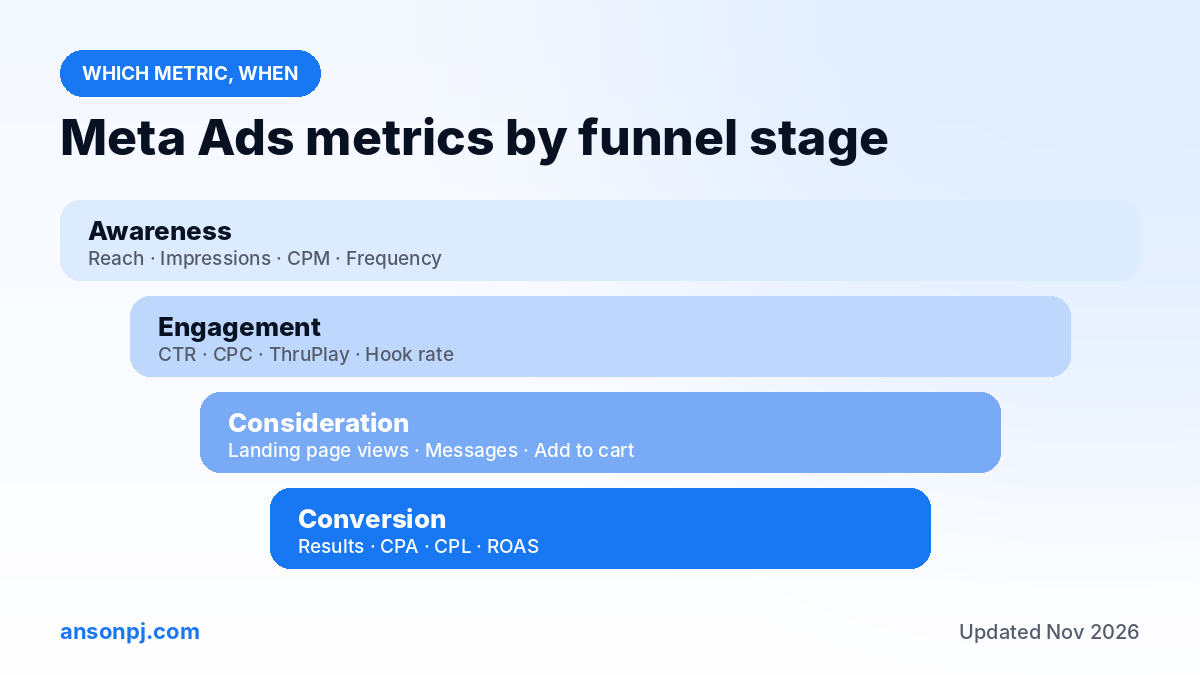
Which Meta Ads metric to check, and when
Not every metric matters for every campaign. Match the metric to the stage of the funnel your campaign is working on:
Example: reading the numbers for a ₹5,000 campaign
Say a small shop spends ₹5,000 and Ads Manager shows 2,50,000 impressions, 1,00,000 reach, 2,500 link clicks and 50 leads. Here's what that means:
| Metric | Calculation | Answer |
|---|---|---|
| CPM | ₹5,000 ÷ 2,50,000 × 1,000 | ₹20 |
| Frequency | 2,50,000 ÷ 1,00,000 | 2.5 |
| CTR (link) | 2,500 ÷ 2,50,000 × 100 | 1% |
| CPC | ₹5,000 ÷ 2,500 | ₹2 |
| CPL | ₹5,000 ÷ 50 | ₹100 |
| Conversion rate | 50 ÷ 2,500 × 100 | 2% |
This is a made-up example to show the maths. What counts as a "good" CPM, CTR or CPL depends on your industry, location, offer and season, so compare against your own past campaigns first.
Real numbersA real Ads Manager example
Here's how these terms look in campaigns I've run, taken from my ad results page:
| Campaign type | What Ads Manager showed | Terms in action |
|---|---|---|
| Website sales (Feb 2026) | ₹15,863.73 spent, 305 purchases, ₹1,37,446 purchase value | Cost per purchase ₹52.01 (15,863.73 ÷ 305); ROAS 8.66 (1,37,446 ÷ 15,863.73) |
| Messaging | 799 messaging conversations | Cost per result ₹34.73 |
| Video | 1,76,292 ThruPlays | Cost per ThruPlay ₹0.03 |
Note: these are past results from specific campaigns, not guaranteed future results. Every business, budget and offer performs differently.
Meta Ads terms: frequently asked questions
What is CPA in Meta Ads?
CPA means cost per action. It is the average amount you pay for one conversion, such as a purchase, lead or sign-up. Formula: total spend ÷ number of conversions. In Ads Manager it shows as cost per result.
What is CPM in Meta Ads?
CPM is cost per mille, the amount you pay for 1,000 impressions. Formula: spend ÷ impressions × 1,000. A rising CPM means your audience is getting more expensive to reach.
What is the difference between reach and impressions?
Reach is the number of unique people who saw your ad. Impressions is the total number of times it was shown. If 1,000 people saw your ad 3 times each, reach is 1,000 and impressions are 3,000.
What is a good ROAS for Meta Ads?
There is no single good ROAS; it depends on your profit margin. If your margin is 50%, you need a ROAS above 2 just to cover product cost. Work out your break-even ROAS first, then set targets above it.
What is a good CTR for Meta Ads?
It depends on your industry, audience and placement. Compare link CTR across your own ads: the ones with higher link CTR usually have the stronger hook or offer.
What does learning limited mean in Meta Ads?
Learning limited means Meta expects the ad set will not get enough optimisation events, about 50 in 7 days, to exit the learning phase. Fixes include raising budget, combining ad sets or choosing a more frequent optimisation event.
What is ThruPlay in Meta Ads?
A ThruPlay is counted when a video is watched to the end, or for at least 15 seconds if it is longer than 15 seconds. Cost per ThruPlay shows how much each meaningful video view costs.
What is the default attribution setting in Meta Ads in 2026?
For campaigns optimising for website conversions, the default is 7-day click-through, 1-day engage-through and 1-day view-through. Meta stopped returning the 7-day view and 28-day view windows on 12 January 2026.